

Gatesville is the seat of Gates County and its only incorporated town, a place of a few hundred people in the middle of the county where a courthouse has stood since the Revolution1. Before it was a town it was a landing, and before it had a courthouse it had a creek.
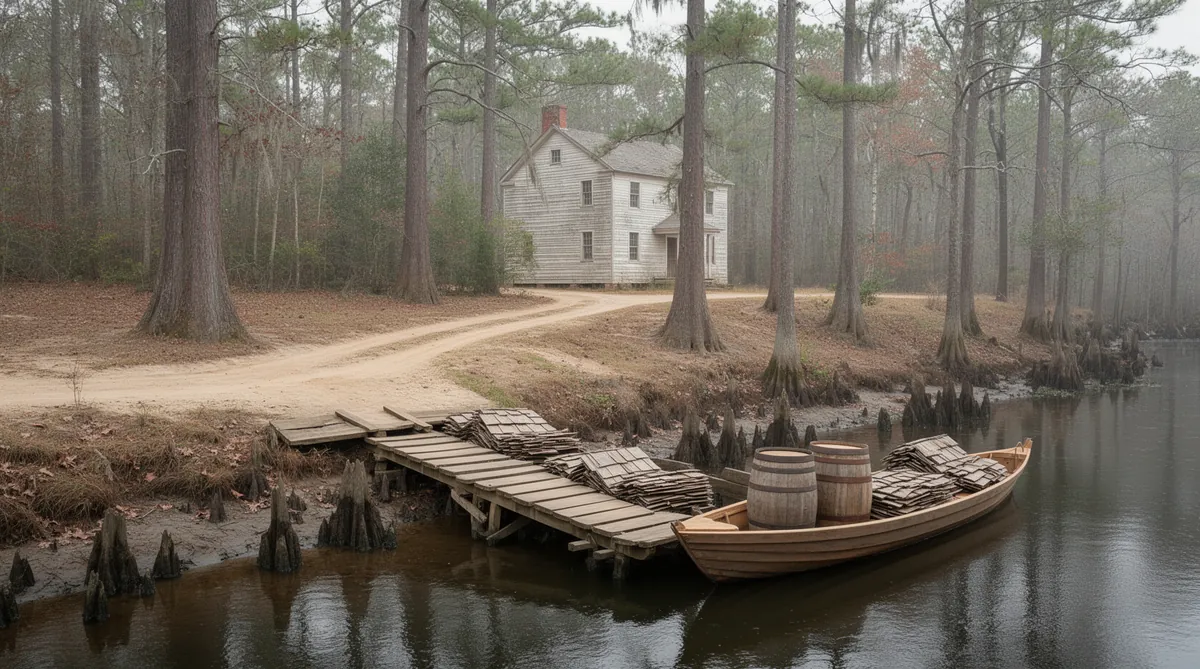
Before 1779 Bennetts Creek Landing
Bennetts Creek begins in the middle of Gates County, where Duke, Harrell and Raynor swamps run together, and winds down to the Chowan River. William S. Powell's North Carolina Gazetteer says it takes its name from Richard Bennett, governor of Virginia from 1652 to 1655, and that it was already drawn on John Ogilby's map of 16712. The same gazetteer records that the town on its bank was first called Bennetts Creek Landing1.
The earliest traveler's account tied to the spot comes from the Quaker preacher George Fox, who crossed this country around 1672. Writing a history of the county in 1916, Isaac S. Harrell read Fox's journal as describing a ride of about twelve miles from Somerton, Virginia, past a single house, to a lone dwelling on what Fox called Bonner's Creek, the stream now named Bennetts, at the site of present-day Gatesville. Fox spent the night and went on down the creek toward the Chowan and Edenton3. A 1978 state park plan tells the same story with a date attached, placing Fox in camp on Bennetts Creek on September 20, 16724. Both accounts are interpretations of Fox's journal rather than a survey, so treat the exact spot as tradition.
What made the landing matter was the water. Harrell called Bennetts Creek the only navigable stream in the county, and he described farmers around Gatesville sending what little they had to sell down the creek to the Chowan, while their neighbors near the Virginia line looked north to the Dismal Swamp canal and Norfolk instead5. The Methodist bishop Francis Asbury noticed the same thing on a visit in March 1799, writing in his journal that the creek gave a landing at Gates Court House and reached the Chowan a few miles farther on6.
1779–1831 Gates Court House
The General Assembly created Gates County in 1779 from pieces of Chowan, Hertford and Perquimans counties and named it for Horatio Gates, the general credited with the American victory at Saratoga in 17777. The act that formed the county also called for commissioners to pick a central site for a courthouse. According to the courthouse's National Register nomination, the first building went up around 1781, when the legislature levied a tax to pay for it, and once it stood, the landing became known as Gates Court House8. The county government's own history puts it a year earlier, saying a courthouse, a prison and stocks were built in 1780, and it describes the 1781 tax as money to finish the public buildings9. The two dates may describe the same project at different stages; this page gives both.
The village had a post office early. A catalog of North Carolina postal history lists Daniel Southall as the first postmaster at Gates Court House, appointed March 9, 180310.
The present name came from the legislature. In its 1830–31 session the General Assembly declared that the place then known as Gates Court House would from then on be known as Gatesville, and the post office followed on February 27, 1831810. Powell's gazetteer and a 2006 National Register nomination both give 1830 as the year the town was incorporated111. The act quoted in the courthouse nomination is the renaming act, and its full text is not published online, so whether it also set up a town government is not settled here. The charter Gatesville operates under today is a 1923 private act, discussed below.
1834–1836 The Brick Courthouse
By 1834 the first courthouse needed serious repair, and the county court chose to replace it. To pay for the new building the justices set a tax of fifty cents on each poll and twenty cents on every hundred dollars of land value. That August a majority of the court scaled the plans back, calling for a building forty feet square with no porch or portico and with the courtroom on the ground floor. The work finished in May 1836, the court held its first session in the new building that August, and the old courthouse was sold to Marmaduke Norfleet for $33.5012.
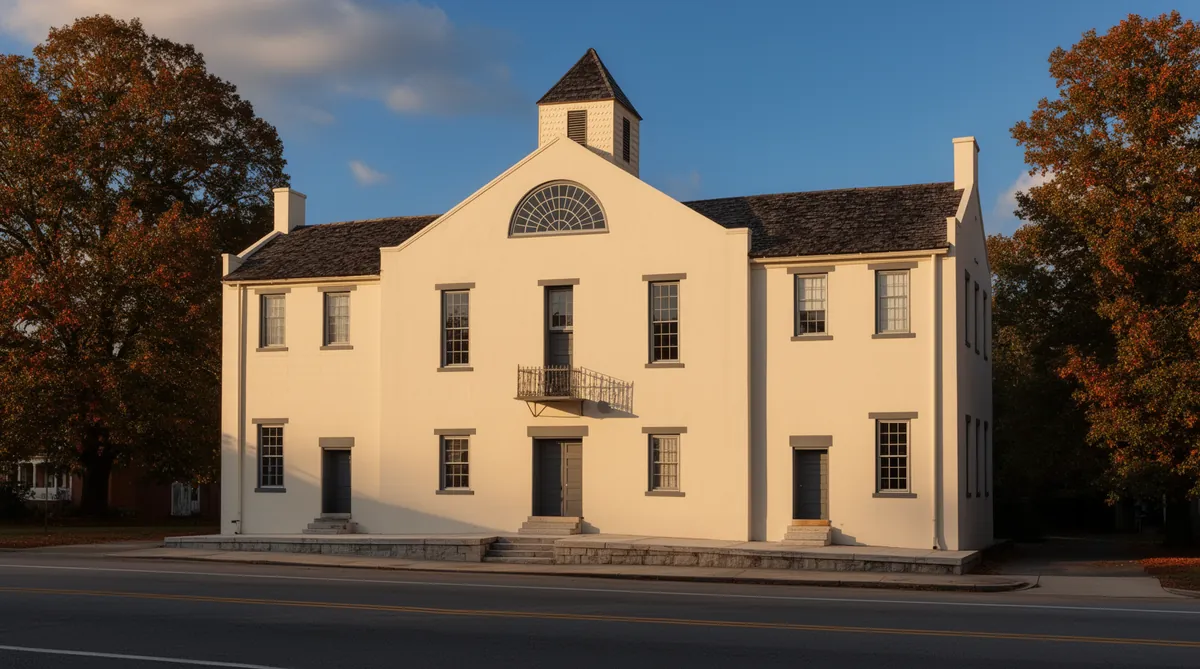
The court minutes quoted in the nomination show the justices protecting their investment. They put the clerk, William Daughtry, in charge of cleaning the building and airing it out, bought three dozen spit boxes, and posted a list of fines: fifty cents for chewing tobacco and spitting on the floor, fifty cents for writing on the walls, and a dollar for cutting the woodwork12.
The man paid for building it was Dr. John B. Baker, a physician and large landowner who served in the state House of Commons in 1811 and the state Senate from 1818 to 1838. The nomination records a second payment to him of $1,673 in May 1836 and smaller payments to the sheriff, James R. Riddick, and others for extra work and for painting the brick. It also notes that Baker's estate included enslaved people and more than 2,000 acres in the county, and that it is not known whether he designed the building or whether men he hired or held in slavery did the work13. The same document says the courthouse lot was probably land a John Baker deeded in 1794; since it also gives Dr. Baker's birth year as 1785, the 1794 seller was more likely an older man of the same name13.
Fifty cents for spitting on the floor, fifty cents for writing on the walls, a dollar for cutting the woodwork.
The building has changed in stages. The brick was stuccoed and the small cast-iron balcony added in 1904, and a rear wing with a jail went on in 1940. When the nomination was written in 1976 the county was about to move its offices and courts into a new building that June. The nomination ranks the 1836 courthouse among the few antebellum courthouses left in North Carolina and calls it a restrained late Federal design14. It was listed on the National Register the same year, and the county reports that it now houses the Gates County Public Library and the Gates County Historical Society9.
1799–1860 Academies, Churches & the Clerk
In the first half of the nineteenth century the courthouse village was also a church and school town. Asbury's journal records him preaching at Gates Court House to "many serious people" on Sunday, March 10, 1799, and administering the sacrament there6. Harrell found that Asbury kept returning after 1801, sometimes preaching in the courthouse itself, that he ordained a local man named R. Harrell as a deacon there in 1803, and that the Gatesville Methodist church was built around 1828. The legislature chartered the Gatesville Academy in 1832, the same year it chartered an academy at Sunbury15. Decades later the suffragist Elsie Riddick, born in 1876 on her father's farm six miles from Gatesville, attended a private academy in the town that taught boys and girls together until she was fifteen16.
The county's farm economy rested on slavery. The first federal census, in 1790, counted 5,372 people in Gates County: 3,080 free white residents, 73 free Black residents and 2,219 enslaved people17. The courthouse was where that system was written down. Henry L. Eure, who built the side-passage house that still stands at 212 West Main Street around 1850, was clerk of court from the mid-1850s, and his name appears, from 1854 to 1861, on the county's certificates registering enslaved people to work in the Great Dismal Swamp18.
1861–1915 War and Memory
A Civil War Trails marker that stood beside the courthouse, recorded by the Historical Marker Database before it went missing, said the county militia was headquartered in the 1836 building and that the Gates Guards were organized and mustered into Confederate service there as Company B of the 1st North Carolina Infantry. It said men of the company signed their names on the wall of a second-floor room before they left, and that the county's records, which go back to 1779, were hidden at Allen Smith's house for the rest of the war19.
Gatesville is also where William Paul Roberts is buried. Born in Gates County in 1841, he enlisted in 1861 and was made a brigadier general in February 1865. State historians call him, at twenty-three, the youngest general officer in the Confederate army. After the war he represented the county in the constitutional conventions of 1868 and 1875, served as state auditor from 1880 to 1888, and was later a U.S. consul in Victoria, British Columbia. He died in Norfolk in 1910, and a state highway marker on NC 37 in Gatesville points to his grave nearby20. The county government's history page gives his age as twenty; the state's biographical dictionary and its marker program both say twenty-three, and this page follows them9.
Fifty years after the war, on July 18, 1915, a Confederate monument was unveiled across the street from the courthouse19. It still stands. In 2022 a group of county residents placed a marker beside it that says the honors of that era do not reflect the county's values today and names unity and racial equality as the community's own21.
1880s–1923 A Railroad-Era Town
The arrival of the railroad in the county in the 1880s brought a building boom to Gatesville that lasted into the early twentieth century. The 2006 nomination for the Eure-Roberts House lists the results along the town's four main streets, Court, Main, High and Church: two-story frame houses with scrollwork, lacy porches and bracketed cornices, among them the Richard H. Williams House and the Eason-Sawyer House of about 1885 and the William T. Cross House of 1898, a Queen Anne Baptist church on Court Street in 1908, and a 1911 house on High Street built from Sears, Roebuck plans and materials. The oldest house in town, the Lemuel P. Hayes House on Main Street, dates to about 182018.
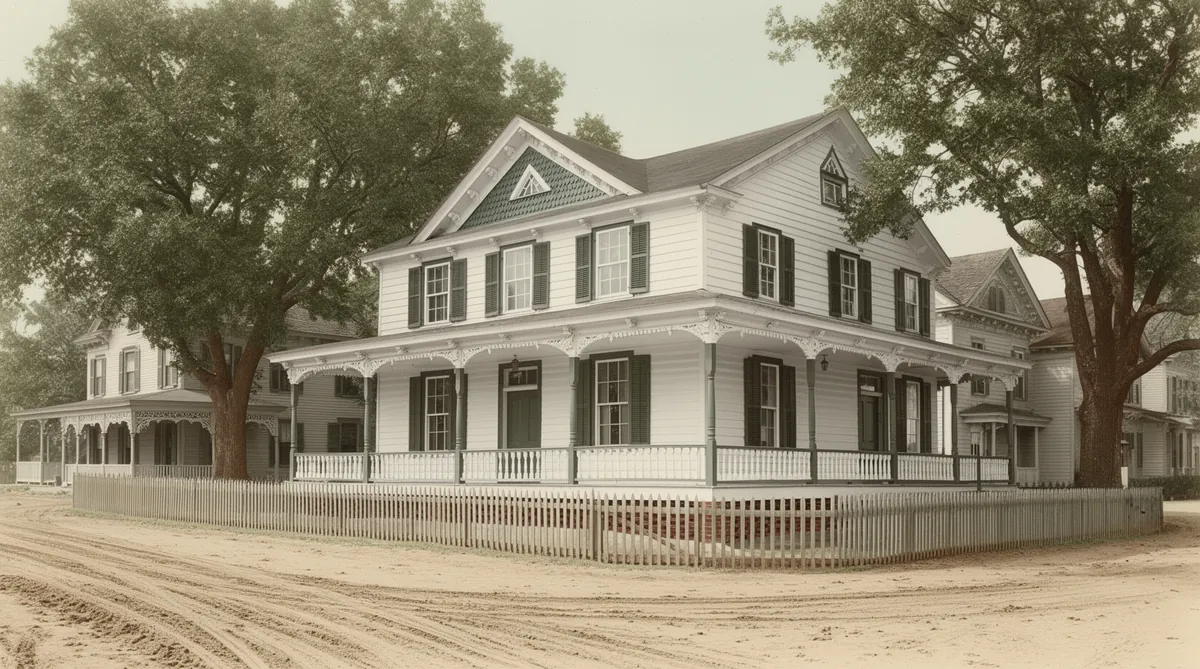
Older houses were brought up to date. When Edward R. Roberts bought the Eure house in 1901 for $750, he and his wife, Annie Cowper Roberts, added a wraparound porch, a bracketed cornice and a shingled front gable, and a room with its own porch door that may have served as his drugstore. By 1920 the census listed Roberts as a druggist, and according to the nomination a branch of the Roberts Drug Company gave the county community of Roduco its name18.
The boom was a matter of buildings more than people. The federal census counted 232 residents in Gatesville in 1890, 200 in 1900 and 203 in 191022. The Eure-Roberts nomination, citing a 1991 architectural survey of the county, describes a town of about 300 at the end of the nineteenth century with six general stores, a furniture store, two confectioneries, a drugstore and several hotels18. The census figures are the official count; the larger number may reflect people living just outside the town line.
The town's present charter dates from this period too. When the General Assembly amended it in 2009, the act identified the charter as Chapter 88 of the Private Laws of 1923, amended in 1933, which provides for a mayor and three commissioners. The 2009 act moved both offices to four-year, staggered terms23.
1882–1951 Reid's Grove School
Reid's Grove School, at 931 Main Street on NC 37, carries a name with roots in 1882. That October, Wilson and Mariah Hudgins deeded a quarter acre on the Somerton Road to the three-member committee of the Gatesville School District. One of the three was Asbury Reid, a Black farmer and the son of a free Black landowner named Micajah Reid, and the nomination suggests that is why the school on the lot was known as Reid's Grove by the 1920s24.
The present building went up in 1927 with help from the Julius Rosenwald Fund, which shared the cost of rural schools for Black children across the South when local people and governments put up money too. The state's Rosenwald correspondence preserved in the nomination tells a hard story: Black residents of the district signed a $1,000 note to get the school built, the county board started construction on a two-room plan and then sought money for three rooms, and the state's Black Rosenwald agent, George E. Davis, pressed the fund on the community's behalf. The school opened on November 5, 1927, and the fund paid $700 toward it that December24.
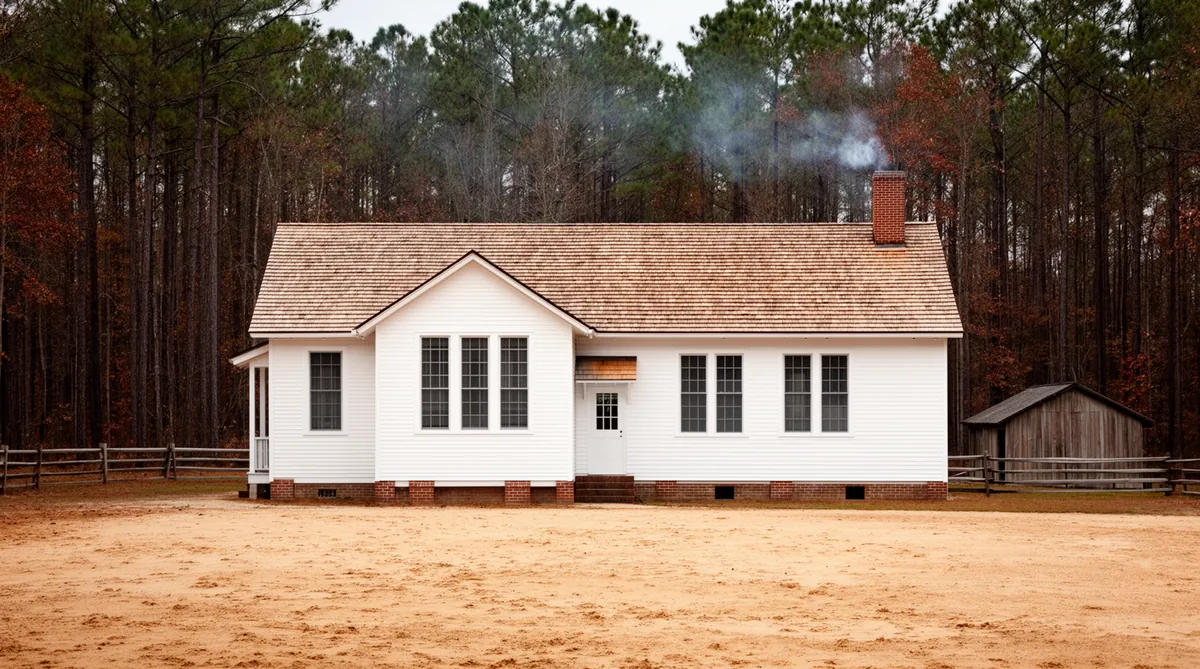
Reid's Grove taught children through the eighth grade until the spring of 1951; older students went on to the T. S. Cooper Training School in Sunbury and, after it burned in the 1940s, to Butler High School. The county took over the building in 1951. It later held the county's 4-H club, then a library for Black residents before integration in the 1960s, and it was renamed the Mitchell Building for Howard Mitchell, whom the nomination calls North Carolina's first Black Cooperative Extension agent. The Economic Improvement Council has owned it since 1999. It was listed on the National Register on August 30, 201124.
Present The Town Today
The 2020 Census counted 267 people in Gatesville, on 0.404 square miles of land, and the Census Bureau estimated 260 residents on July 1, 202526. The 1836 courthouse, the Eure-Roberts House and Reid's Grove School are all on the National Register. Listing on the Register, by itself, puts no obligation or restriction on a private owner who maintains or changes a building with private money; obligations attach only when federal money, a federal license, a grant or a tax credit is involved27.
The line matters in three practical ways. Inside it, the town's property tax is added to the county's; the commuter cost chapter has the published rates and their fiscal year. Building permits and inspections run through the county's office for both the town and the unincorporated county, as the building chapter explains. And FEMA lists Gatesville as its own flood-insurance community with its own effective map date, separate from the county's29, so check the parcel itself on the state's flood map viewer rather than assuming. For houses old enough to have a story of their own, the older homes listings are the place to start.
Primary Sources & Further Reading
Gates County Courthouse nomination (1976)
The State Historic Preservation Office's National Register file, built from the county court minutes, deeds and estate records.
Isaac S. Harrell, "Gates County to 1860" (1916)
An early county history published by the Trinity College Historical Society, digitized by East Carolina University.
Reid's Grove School nomination (2011)
The school's history from deeds, state Rosenwald correspondence and interviews with former students.
This page draws on National Register nominations, the census, the General Assembly's session laws, state biographical and marker records, and Harrell's 1916 county history. The most detailed modern source on the town's buildings, Thomas R. Butchko's Forgotten Gates (Gates County Historical Society, 1991), is cited here only where a nomination quotes it; I did not have the book itself. Where two sources disagree, both are given in the text or the notes.
- William S. Powell, The North Carolina Gazetteer, entry "Gatesville": "town and county seat in central Gates County. Alt. 40. Inc. 1830. Known originally as Bennetts Creek Landing and as Gates Courthouse from 1779 until 1830," as published on NCpedia, ncpedia.org/gazetteer/g?page=10, read October 24, 2026. ↩
- Powell, North Carolina Gazetteer, entry "Bennetts Creek," NCpedia, ncpedia.org/gazetteer/b?page=88. ↩
- Isaac S. Harrell, "Gates County to 1860," Historical Papers of the Trinity College Historical Society, Series XII (Durham, 1916), pp. 60–61, citing Fox's journal for 1672; digitized by East Carolina University, digital.lib.ecu.edu/13570. ↩
- N.C. Department of Natural Resources and Community Development, Division of Parks and Recreation, Merchants Millpond State Park Master Plan (dated February 20, 1978), "Merchants Millpond History," archive.org. ↩
- Harrell, "Gates County to 1860," as in note 3, p. 58 (Bennett's Creek as the county's only navigable stream) and the section on economic conditions (crops sent down the creek to the Chowan). ↩
- The Journal of the Rev. Francis Asbury, Bishop of the Methodist Episcopal Church, from August 7, 1771, to December 7, 1815, vol. II (New York: N. Bangs and T. Mason, 1821), p. 340, entries for March 10 and 11, 1799, archive.org. ↩
- Allyson C. Criner, "Gates County," NCpedia (2006), ncpedia.org/geography/gates: formed in 1779 from Chowan, Hertford and Perquimans; named for Horatio Gates; the seat called Gates Court House until 1831. A 2006 National Register nomination (note 11) gives the formation year as 1778; the formation act and the state's encyclopedia say 1779. ↩
- National Register of Historic Places Inventory–Nomination Form, "Gates County Courthouse," Gatesville, research by Joe Mobley, N.C. Division of Archives and History (1976), Section 8, citing David Leroy Corbitt, The Formation of the North Carolina Counties, and Public and Private Laws of North Carolina, 1830–1831, Chapter 69, files.nc.gov/ncdcr/nr/GA0002.pdf. ↩
- Gates County government, "History," gatescountync.gov/history, read October 24, 2026 (the 1780 courthouse, prison and stocks; the 1781 tax; the 1836 courthouse's present use; William P. Roberts "at age 20"). ↩
- R. F. Winter, North Carolina Postmark Catalog: Gates County, North Carolina Postal History Society (August 15, 2024), entries "Gates C.H., Gatesville" (Daniel Southall, March 9, 1803; name changed to Gatesville, February 27, 1831) and "Gates, name changed from Adoir" (October 5, 1903), ncpostalhistory.com (PDF). ↩
- National Register of Historic Places Registration Form, "Eure-Roberts House," 212 West Main Street, Gatesville (listed 2006), Section 8, p. 3: "The town of Gatesville, not incorporated until 1830, formed around the Gates County Courthouse," files.nc.gov/ncdcr/nr/GA0374.pdf. ↩
- Gates County Courthouse nomination, as in note 8, Section 8, citing the Gates County Court of Pleas and Quarter Sessions minutes for May 19, 1834, August 20, 1834, February 1836 and May 1836. ↩
- Gates County Courthouse nomination, as in note 8, Section 8, citing the court minutes for 1835–36, Gates County Original Deeds of Sale (John Baker to Thomas Hunter, August 21, 1794) and Baker's 1839 estate records. The observation that the 1794 grantor was probably not the Dr. Baker born in 1785 is mine, drawn from the dates the nomination itself gives. ↩
- Gates County Courthouse nomination, as in note 8, Sections 7 and 8 (1904 stucco and balcony; 1940 rear addition with jail; the planned move to a new building in June 1976; "one of a small number of antebellum courthouses surviving in the state"). Listing year: National Park Service, National Register of Historic Places spatial dataset, County = Gates, as cited on this site's county history page. ↩
- Harrell, "Gates County to 1860," as in note 3, sections on education and churches, citing Asbury's journals, the Private Laws of 1832 and local Methodist records. Harrell flags parts of his church history as resting on local tradition. ↩
- "Riddick, Elsie Garnett" (15 Nov. 1876–23 Dec. 1959), Dictionary of North Carolina Biography, ed. William S. Powell, on NCpedia, ncpedia.org/biography/riddick-elsie. ↩
- Harrell, "Gates County to 1860," as in note 3, p. 63, from the 1790 federal census. ↩
- Eure-Roberts House nomination, as in note 11, Section 8, pp. 3–7 and note 2, citing Raymond Parker Fouts, comp., Registration of Slaves to Work in the Great Dismal Swamp, Gates County, North Carolina, 1847–1861 (1995), Gates County deed books, and Thomas R. Butchko, Forgotten Gates: The Historical Architecture of a Rural North Carolina County (Gates County Historical Society, 1991). ↩
- North Carolina Civil War Trails marker "Gates County Courthouse" (Civil War muster ground), text as transcribed with photographs by the Historical Marker Database, which reports the marker missing as of July 2024, hmdb.org. ↩
- "Roberts, William Paul" (11 July 1841–27 Mar. 1910), Dictionary of North Carolina Biography, sketch by Paul Branch, on NCpedia, ncpedia.org; N.C. Department of Natural and Cultural Resources, "William P. Roberts, A-32," North Carolina Highway Historical Marker Program, dncr.nc.gov. ↩
- "United We Stand" marker, erected 2022 by citizens of Gates County, Court Street at New Ferry Road, text and photographs as recorded by the Historical Marker Database, hmdb.org. ↩
- U.S. Bureau of the Census, Thirteenth Census of the United States (1910), Statistics of Population for North Carolina, Table 1, "Population of Minor Civil Divisions: 1910, 1900, and 1890," p. 577, Gatesville town 203 / 200 / 232; copy hosted by the Town of Boone, boonenc.gov (PDF). The reading of the 1890 figure is mine from the page scan. ↩
- S.L. 2009-17, "An Act Amending the Charter of the Town of Gatesville to Extend the Terms of Office for the Mayor and Members of the Board of Commissioners from Two to Four Years and Staggering Those Terms," ratified April 29, 2009, ncleg.gov. ↩
- National Register of Historic Places Registration Form, "Reid's Grove School," 931 Main Street (NC 37), Gatesville, prepared by Penne Sandbeck (2011), Section 8, citing Gates County deed books, the Rosenwald Fund records of the N.C. Department of Public Instruction, Division of Negro Education, and a March 16, 2011 group interview with former students, files.nc.gov/ncdcr/nr/GA0276.pdf; listing date from National Park Service, NPGallery, NRIS 11000621, npgallery.nps.gov. ↩
- National Register of Historic Places Registration Form, "Sunbury High School," Sunbury (listed May 12, 2009), Section 8, p. 7, citing Butchko, p. 41, files.nc.gov/ncdcr/nr/GA0318.pdf. ↩
- U.S. Census Bureau, 2020 Census Redistricting Data (P.L. 94-171), North Carolina, Gatesville town (place 3725680), total population 267; 2020 Census Gazetteer, places, North Carolina, land area 0.404 square miles; Population Estimates Program, Vintage 2025 subcounty totals (sub-est2025_37.csv), POPESTIMATE2025 = 260, www2.census.gov, read October 24, 2026. ↩
- N.C. State Historic Preservation Office, "National Register Fact Sheet 1: What Is the National Register of Historic Places?", hpo.nc.gov (PDF). ↩
- Park address and coordinates (36.4371, -76.7016): NC State Parks, "Merchants Millpond State Park," ncparks.gov, read October 24, 2026. Town center (36.4074, -76.7566): 2020 Census Gazetteer, as in note 26. The distance is my own straight-line calculation between the two points. ↩
- FEMA, OpenFEMA "NFIP Community Status Book," Town of Gatesville (community 370104), current effective map date August 3, 2009; Gates County unincorporated areas (community 370103), December 21, 2018; records last refreshed August 25, 2026, read October 24, 2026, fema.gov. Parcel-level flood zones: North Carolina Flood Risk Information System, fris.nc.gov. ↩